Your reMarkable notebooks,
searchable in Claude.
rm-brainis a local-first “second brain” that syncs the notebooks you drop into a Brain folder, transcribes the handwriting with Claude, and lets you ask questions about your own notes — right inside Claude Desktop, with citations to the exact page. Prefer a UI? Everything is also browsable and searchable in a local web app.
A quiet system that organizes itself
Less a search box, more a system that surfaces things you forgot you wrote.
Handwriting, understood
Claude vision transcribes messy handwriting and diagrams, then classifies each page — journal, meeting, idea, decision.
Open loops surfaced
Every to-do, follow-up and unresolved question is flagged, so “what did I forget?” actually has an answer.
Entity timelines
See every page that mentions a person, project or topic in order — watch how your thinking evolved over time.
Search that forgives typos
A local SQLite + FTS5 index over your transcribed notes — partial words and small spelling mistakes still find the page. Fast, offline, and yours.
Ask Claude, or browse
Query your notes in Claude Desktop over MCP with citations — or open the local web app and browse them yourself.
Private by design
Local-first. Your notes stay on your machine — no hosted database, no telemetry, no reMarkable jailbreak.
Two ways in
Ask Claude, or open the browser — the same local index, whichever fits the moment.
Ask Claude Desktop
The MCP server hands your notes to Claude. Ask “what are my open loops?” or “what did I decide about pricing?” and get an answer with citations to the exact page.
Browse the local web app
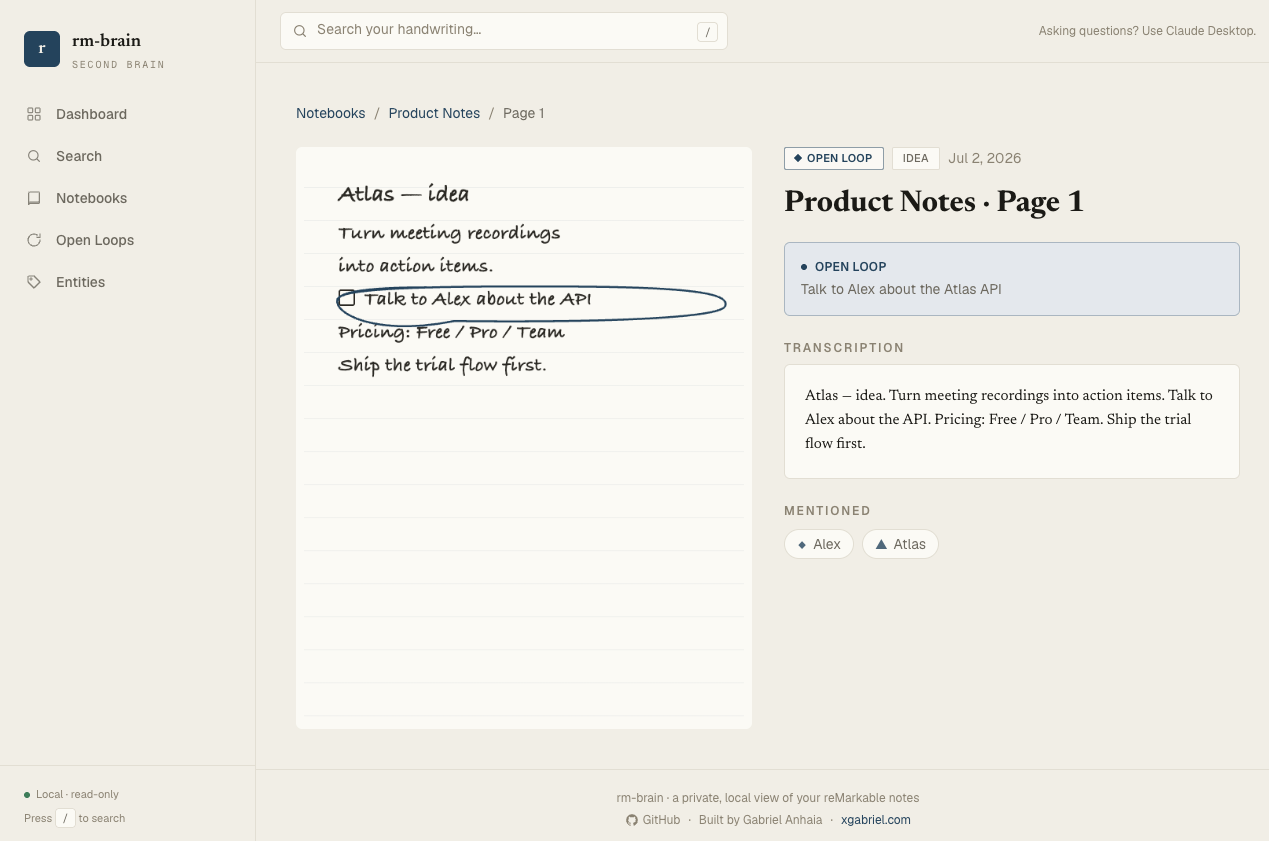
A read-only, ink-on-paper reading room for your handwriting: a dashboard, typo-tolerant search, open loops, entity timelines, and notebooks grouped by their reMarkable folder. Runs on localhost — nothing leaves your machine.
How it works
One Claude vision call per page. Nothing leaves your machine except the page being read and the questions you ask.
Yours, and only yours
The database, page images, and index live in a single folder on your Mac. The only things that ever touch the network are the page images sent to the Claude API while indexing, and the queries you make while searching.
Talk to your notebook.
Free, open source, and running on your own machine in a few minutes.
Node · TypeScript · SQLite · FTS5 · MCP · React · MIT